
Have you ever walked past a giant billboard and then two minutes later seen an ad for the exact same brand pop up on your Instagram feed?
That is the world we live in today. Two very different marketing strategies, both trying to get your attention. One has been around for decades. The other is reshaping entire industries and creating thousands of new career opportunities every single year.
If you are a student in India trying to understand the marketing world, or even thinking about building a career in digital marketing, you have probably wondered: what exactly is the difference between traditional marketing vs digital marketing? And between the two, which one should I actually learn for a future-proof career in India?
This blog breaks it all down in simple, plain language , no confusion.
What is Traditional Marketing?
Traditional marketing refers to any form of promotion that does not involve the internet. It is the older approach that businesses have used for decades to reach their audiences.
Think of it this way: before smartphones, before Google, and before social media, how did companies get the word out about their products? They used newspapers, television commercials, radio spots, hoardings, flyers, and direct mail. That is traditional marketing in a nutshell.
Common forms of traditional marketing include:
- Television and radio advertisements
- Newspaper and magazine print ads
- Billboards and outdoor hoardings
- Pamphlets, brochures, and flyers
- Cold calling and direct mail
- Event sponsorships and trade shows
Traditional marketing is broad and powerful when it comes to reaching a general, large audience. A TV commercial during prime time can reach millions of people. A newspaper ad in a national daily can land in front of lakhs of readers. The reach is undeniable.
But here is the thing: you cannot choose exactly who sees your billboard. You cannot track whether someone actually bought your product because they saw your newspaper ad. You just spend the money and hope for the best.
What is Digital Marketing?
Digital marketing is any form of marketing that happens online or through digital devices. It uses the internet, social media platforms, search engines, email, websites, and mobile apps to promote products and services.
The big difference here is precision. With digital marketing, you can target a 22-year-old college student in Bangalore who is interested in fitness and has been searching for protein supplements online. You can show your ad only to that specific person and track exactly what they do after seeing it.
Common forms of digital marketing include:
- Search Engine Optimization (SEO)
- Pay-Per-Click advertising (Google Ads, Meta Ads)
- Social media marketing (Instagram, LinkedIn, YouTube)
- Email marketing
- Content marketing and blogging
- Influencer marketing
- Video marketing
- Affiliate marketing
Digital marketing is not just about ads though. It is about building a presence, creating content that people actually want to read or watch, and building relationships with your audience in a way that traditional marketing simply cannot match.
Traditional Marketing vs Digital Marketing: The Key Differences
Let us put them side by side so things get crystal clear.
| Factor | Traditional Marketing | Digital Marketing |
|---|---|---|
| Reach | Broad, untargeted | Targeted and specific |
| Cost | Usually high | Can start very low |
| Measurability | Difficult to track | Highly trackable in real time |
| Engagement | One-way communication | Two-way, interactive |
| Flexibility | Hard to change once live | Can be edited anytime |
| Speed | Slow to launch | Can go live within hours |
| Audience | Mass audience | Specific audience segments |
| Feedback | Delayed or no feedback | Immediate feedback and data |
This table alone tells a big story. Traditional marketing is like throwing a wide net into the ocean and hoping something comes back. Digital marketing is more like fishing with precision gear where you know exactly what you are looking for and where to find it.
Why is Digital Marketing Booming Right Now?
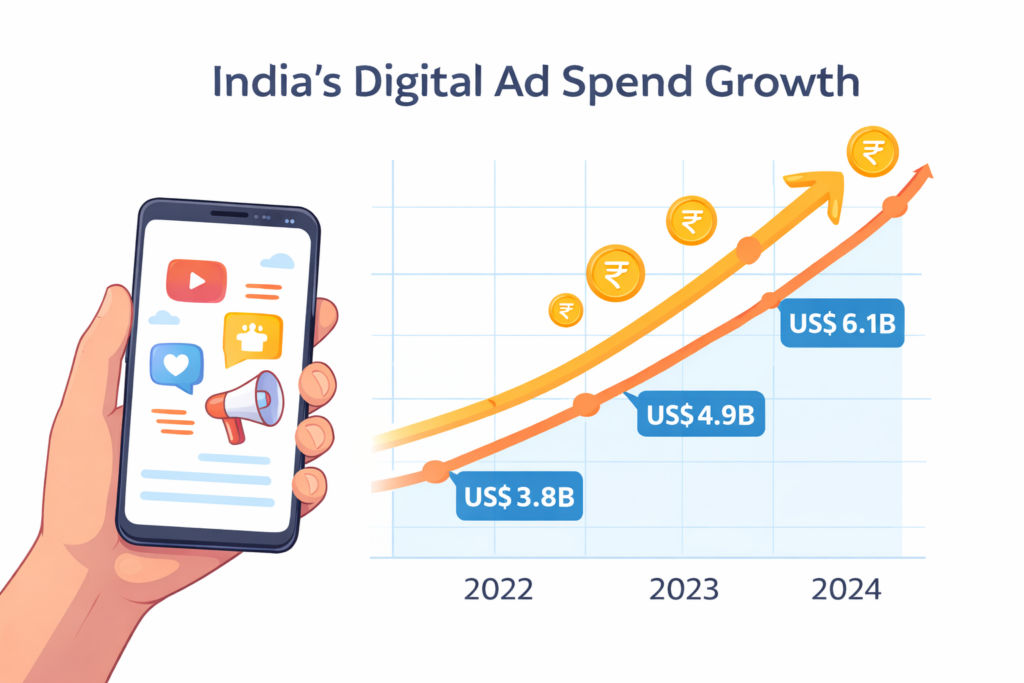
This is the part students really need to pay attention to. The numbers going into 2026 are staggering.
According to India Digital Advertising Market data, India’s total advertising industry grew 6.3% in 2024 to reach Rs 1,01,084 crore and is projected to hit Rs 1,15,460 crore by 2026. Of that, digital advertising is the single biggest growth engine, having already surged 21.1% in 2024 to Rs 49,251 crore and forecast to reach Rs 69,856 crore by 2026, representing a dominant 61% share of total advertising spend.
Digital is not just ahead of television anymore. By 2026 it will command nearly two-thirds of all advertising money in India.
The India digital marketing market, valued at USD 6.71 billion in 2025, is now growing at a CAGR of 30.2% through 2035, with projections putting it at USD 93.94 billion by 2035. And closer to home, the digital marketing industry in India is expected to reach Rs 537 billion by the end of 2026. That is not a niche. That is a full-blown economy.
And here is what is driving all of this growth:
900 million internet users and counting. India is now the second largest online market in the world, with around 900 million internet users. Every new user coming online is a potential customer for some brand, and those brands need digital marketers to reach them.
Mobile-first India. Smartphones account for 53.9% of all digital advertising revenue. People are not sitting at desktops anymore. They are scrolling, watching, searching, and buying through their phones. Brands not optimising for mobile are already behind.
The Digital India push. The Indian government’s Digital India initiative has been actively expanding internet infrastructure, especially into Tier II and Tier III cities. Over 73% of internet subscribers in India now consume content in regional languages, creating a Rs 4.5 lakh crore market opportunity that brands are rushing to tap.
E-commerce and influencer explosion. India’s influencer marketing industry alone is projected to reach Rs 3,375 crore by 2026, growing at 18% CAGR. The rise of D2C brands, short-form video, and social commerce has made digital marketing an absolute necessity for businesses of all sizes.
This is why digital marketing is booming. It is not a trend. It is a structural shift in how the entire economy operates.
So, Should You Choose Digital Marketing or Traditional Marketing as a Career in India?
Let us be honest with you here because this is the question most students actually want answered.
If you are a student deciding what to learn or what career to build, the answer is almost certainly: focus on digital marketing.
Here is why.
Traditional marketing jobs are not growing at any meaningful pace. Newspaper circulation is declining. Television viewership among young audiences is dropping. Radio advertising budgets are shrinking. The budgets, the jobs, and the future are all shifting decisively to digital.
On the other hand, digital marketing is one of the fastest-growing career fields in India right now. The industry is projected to grow at a CAGR of 38.9% between 2025 and 2031 according to 6Wresearch, with one of the key challenges flagged being a severe shortage of skilled professionals. That talent gap is your opportunity as a student. LinkedIn has reported a consistent year-on-year increase in digital marketing job postings in India, and digital marketing salaries have increased on average by 30% in just the past year alone.
Bengaluru, where many of you reading this might be based or planning to move to, is one of the top hiring hubs for digital marketing roles. According to the Kraftshala Digital Marketing Trends Report 2024, Bengaluru leads in competitive compensation, with 28% of roles in the city offering higher packages compared to other cities.
That said, traditional marketing knowledge is not useless. Understanding how brand storytelling works, how mass campaigns are planned, and how consumer psychology drives purchase decisions are skills that apply to both worlds. Some of the most effective marketers today blend traditional thinking with digital execution.
But if you are starting fresh, go digital first.
Advantages and Disadvantages: Laid Out Clearly
Advantages of Traditional Marketing
- Wider reach for older demographics: A large portion of India’s 50+ population still relies on television and newspapers for news and entertainment. For brands targeting these audiences, traditional media remains effective.
- High credibility and trust: A TV commercial or a full-page newspaper ad still carries a sense of legitimacy for many consumers. It signals that a brand has invested significantly.
- No internet required: In areas with poor connectivity, traditional marketing is the only way to reach people. Outdoor hoardings, for instance, work around the clock without any bandwidth.
- Tangible formats: A flyer or a brochure can be picked up, kept, and referred to later. Physical touchpoints can sometimes be more memorable.
Disadvantages of Traditional Marketing
- Expensive to execute: A 30-second TV ad on a national channel can cost lakhs or even crores. A full-page newspaper ad in a leading daily is not cheap either. This puts it out of reach for small businesses and startups.
- Hard to measure: You can never know exactly how many people saw your billboard and then made a purchase. Attribution is nearly impossible.
- No targeting: Your ad reaches everyone who watches that channel or reads that paper, whether they are your target customer or not. This leads to a lot of wasted spend.
- Slow to change: Once a print ad goes out or a TV commercial airs, you cannot edit it. If there is a mistake or the market changes, you are stuck.
Advantages of Digital Marketing
- Precise targeting: You can target ads based on age, location, interests, search behaviour, income level, and dozens of other parameters. Your budget goes only to people who are actually likely to care about your product.
- Measurable results: Every click, every view, every conversion is tracked. You know exactly what is working and what is not, in real time.
- Cost-effective: You can start running Google or Meta ads with a budget as small as Rs 500. A well-written blog post or a good YouTube video can drive traffic for years without ongoing spend.
- Two-way communication: Customers can comment, share, ask questions, and interact with your brand directly. This builds community and loyalty in a way traditional marketing simply cannot.
- Speed and flexibility: A campaign can be launched in hours. If it is not performing, you can pause it, tweak it, and relaunch it the same day.
- Global reach: A great piece of content can reach people across the world. Indian digital marketers are increasingly working with international clients, which means global career opportunities.
- Data-driven decisions: Everything in digital marketing is backed by data. You are not guessing. You are making informed decisions that improve over time.
Disadvantages of Digital Marketing
- Steep learning curve: SEO, paid ads, analytics, content strategy: each of these is a skill in itself. Getting good takes time and practice.
- Ad fatigue: People are bombarded with digital ads every day and have become very good at ignoring them. Standing out requires genuine creativity and strategy.
- Algorithm changes: Google and social media platforms regularly change how they work. What drives traffic today may not work the same way six months from now.evolving regulations.
- Requires constant attention: Unlike a billboard that stays up for a month on its own, digital campaigns need to be monitored, updated, and optimised regularly.
The Real Benefits of Building a Career in Digital Marketing
Beyond just understanding marketing theory, let us talk about what this means for you as a student.
- Job security in a growing field. With the Indian digital marketing industry expected to hit Rs 537 billion by end of 2026 and demand for skilled professionals far outpacing supply, this is one of the safest career bets you can make right now.
- Competitive salaries. Roles in digital marketing range widely based on specialisation and experience. If you are curious about what digital marketers earn in Bangalore specifically, this detailed breakdown of digital marketing salaries in Bangalore gives you a clear, city-specific picture.
- Variety of roles. SEO specialist, performance marketer, social media manager, content strategist, email marketing executive, analytics consultant, growth hacker, and many more. You can find a niche that genuinely interests you.
- Freelancing potential. Unlike most traditional jobs, digital marketing skills translate directly into freelance income. You can work with clients in Bangalore, Mumbai, or London from your laptop.
- Entrepreneurial advantage. If you ever want to start your own business, knowing digital marketing means you can promote it yourself without depending on expensive agencies.
- Digital marketing is the future. Not just in India but globally. If you want to understand more about why this field is only going to grow bigger, this piece on why digital marketing is the future is worth reading.
A Quick Word on Where to Learn
If you are based in Bangalore or planning to study here, you are in one of the best cities in India to learn digital marketing. The city is a hub for startups, tech companies, and digital agencies, all of which actively hire fresh talent.
Finding the right digital marketing institute in Bangalore matters more than most students realise. The quality of training, the tools you get access to, and the practical exposure you receive during your course will directly shape your early career opportunities.
A structured digital marketing course in Bangalore that covers SEO, paid advertising, social media, analytics, and content creation gives you a full toolkit to enter the industry with confidence. Look for programmes that include live projects and mentorship, not just theory.
From a Student Who Made the Switch: A Real Story
Riya was a BCom graduate from Mysore who had zero background in marketing. She had applied to a few bank jobs, gotten no callbacks, and was genuinely unsure what to do next.
A friend suggested she look into digital marketing. Her first reaction? “Is that even a real job?”
Six months later, after completing a structured digital marketing course in Bangalore, Riya was hired as an SEO executive at a Bangalore-based e-commerce startup at a package of Rs 3.6 LPA. Within a year, she had moved into a performance marketing role handling a monthly ad budget of Rs 8 lakhs for the company.
She says: “What surprised me most was how fast things moved. I expected to spend years figuring things out. But because everything in digital marketing is measurable, I could see results from my work almost immediately. That feedback loop made me learn faster than anything else I had done before.”
Riya’s story is not unusual. It is actually quite common among students who come from non-marketing backgrounds and commit to learning digital skills seriously. The field does not care about your degree. It rewards people who understand data, think creatively, and are willing to keep learning.
Final Thoughts
Traditional marketing is not dead. But the growth, the jobs, the salaries, and the future clearly belong to digital marketing. The data proves it. The market confirms it. And businesses across India are investing more in digital with every passing year.
For students, this is genuinely one of the best times to enter this field. The demand for skilled professionals is far ahead of supply, which means there is room for talented, well-trained people to build strong careers quickly.
Whether you want to work with a startup, join a large corporation, build your own brand, or work as a freelancer, digital marketing skills open all of those doors.
Start learning, stay curious, and remember: the best time to build digital skills was five years ago. The second best time is right now.
Frequently Asked Questions
Is digital marketing better than traditional marketing for beginners?
Yes, for most beginners digital marketing is the smarter starting point. The entry costs are lower, the learning resources are more accessible, and the job opportunities are growing much faster than in traditional marketing.
Can I learn digital marketing without any prior background?
Absolutely. Digital marketing does not require a specific educational background. What matters is your willingness to learn tools, understand data, and stay updated with industry trends. Many of the best digital marketers in India come from engineering, arts, commerce, and other non-marketing backgrounds. All you need is the right digital marketing program to get started.
Is traditional marketing completely irrelevant now?
Not completely. For brands targeting older demographics or running mass awareness campaigns, traditional marketing still plays a role. But most businesses now use digital as their primary channel and traditional as supplementary.
How long does it take to learn digital marketing?
A solid foundation can be built in 3 to 6 months through a structured course. But like any career, real mastery develops through practice, experimentation, and ongoing learning over time.
What is the scope of digital marketing in Bangalore specifically?
Bangalore is one of the top three cities in India for digital marketing hiring, alongside Mumbai and Delhi. The city offers some of the most competitive salaries and access to a wide variety of employers from funded startups to global tech companies.